Does science better explain the concept of “emptiness” through complexity theory?
Buddhists often speak of realizing the “true nature of reality” and strive to achieve this through dedicated contemplative practice. Science can make the same claim: that through a multi-stage process of hypothesis formation, experimental verification, and hypothesis revision, we create an increasingly accurate description of reality. Although the dialogue between Buddhism and science seems to waver between sympathy and turf wars, it deepens every day. I found my own way into this engagement when I was working with stem cells, specifically through what is known as complexity theory, a result of the efforts of mathematicians and representatives of many “hard” and “soft” sciences to understand the rules of behavior of large groups of interacting individuals. Complexity theory postulates a universe of emergent phenomena: Simply put, the idea that things can arise from the spontaneous self-organization of smaller things. This happens, the theory suggests, not only despite a chaotic universe and the absence of a central planner, but precisely because of these conditions. For a Buddhist, whether scientifically interested or not, complexity theory can offer a useful new approach to the often difficult Buddhist concept of Shunyata, or emptiness, the idea that all things lack inherent existence. As central as it is to the Buddhist approach to the universe, emptiness remains an abstraction for many practitioners, something difficult to grasp even intellectually. Complexity theory explains the behavior of many different things, possibly across all levels of observation – from the water in your glass to the neurons in your brain – breaking down cosmological ideas into practical, digestible units, potentially illuminating both the whole and its parts.
What we can learn from real and virtual ants
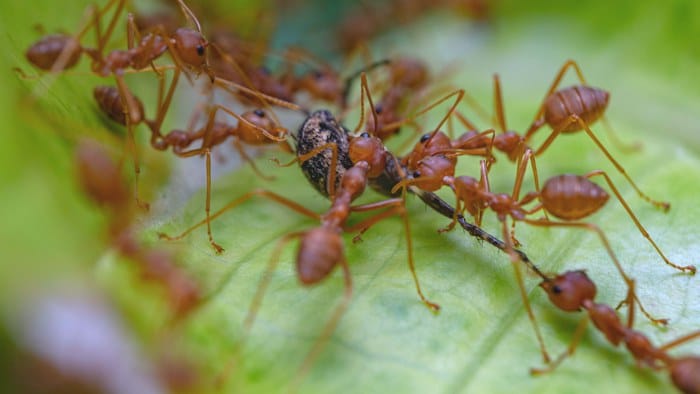
Complexity theory deals with adaptive systems of interacting individuals and how they self-organize into structures and behaviors that are neither planned nor predictable. A well-known example of a complex adaptive system is the ant colony. Ant colonies are artfully structured societies with a garbage dump, cemeteries for dead ants, and lines of workers who bring food into the colony and remove waste and corpses. Some of these forms of organization are undoubtedly so sophisticated that they suggest intelligent design. For example, the distances between anthills, cemetery, and garbage dump are always maximized. This is a complex mathematical calculation and can be seen as an understandable communal desire. However, the structure of a colony has no top-down central planner; it self-organizes from the bottom up. As members of a complex adaptive system, ants self-organize into larger structures and behaviors, such as food lines and mound builders, which constantly change and adapt to altered environmental conditions, allowing the colony to survive for many generations of ants.
The absence of obvious planning for such an organization has been confirmed by computer models of the behavior of individual “virtual ants,” which also spontaneously self-organize and form a “virtual colony” with the same sophisticated structures as natural colonies. The computer programmers do not program the organization of the virtual colony, but only the behaviors of the individual virtual ants, which then self-organize, just like the real colony.
Order without an Organizer
Ants are just one example of this self-evolving form of organization. It can be found throughout the environment, where interacting units of any size – molecules, cells, individual animals and plants, social groups, cultures – meet certain simple criteria:
- There must be numerous individuals, and the number matters. Colonies of different sizes exhibit different organization, just as a village is not a city.
- Individuals must interact with each other and with their environment through negative feedback loops, like a thermostat that turns off the heater when a room gets too warm. There can also be positive feedback loops – imagine the heater being turned up more the warmer a room gets – but if these are not balanced by sufficient negative feedback loops, self-organization may occur, but it will not function: it will be energy-intensive and not adaptive, and the system will quickly burn out – think of hurricanes, tornadoes, or cancer.
- Individuals must react directly to their local environment without monitoring the group as a whole. There is no single ant that monitors the food supply for the entire colony. Rather, each ant reacts only to what it perceives in its immediate surroundings: food, water, dirt, other ants, etc.
- There must be a certain degree of randomness in the system, often referred to as damped disorder.
From Stem Cell to Sangha
I first became aware of the nature and significance of damped disorder when I pursued an interdisciplinary collaboration with British artist Jane Prophet, who noticed that some stem cell behaviors highlighted in my research resembled those of ants. She pointed out that in the straight, efficient food lines of the ant colony, one can repeatedly observe ants deviating from the line. While these ants do not seem to serve an obvious function in food gathering, they are in reality the ants that most efficiently find a new way to bypass a sudden interruption in the food line. These ants are the damped disorder in this system. In our research, my colleagues and I found that while most stem cells produce more of the tissues from which they originate (e.g., blood from blood stem cells), a small number of them eventually form cells of other organs (e.g., liver, lung, intestine, skin). However, these results were often criticized as being so rare as to be trivial and physiologically unimportant. Jane suggested that these might be the cellular equivalent of the divergent ants, the damped disorder in the system that allows cells to function as members of a complex adaptive system that self-organizes, from embryo to fetus to postnatal life, to our own tissues, organs, and bodies.
The Self-Organization of Things
HOW DOES THIS FIT INTO Buddhist metaphysics? It begins with recognizing that complex systems can exist in hierarchies. Back to the ant colony: From a distance, the colony looks like a unified entity, a single unit, a dark shape moving on the sand. Upon closer inspection, however, it becomes clear that it is by no means a unified entity, but a multitude of individual ants organizing themselves in space and time. At the microscopic level, in turn, the body of the individual ant as a thing disappears into the self-organization of its individual cells. Inherent existence as a thing, rather than as an organizational phenomenon of smaller things, depends on the level of observation.
Thus, each level of emergence arises from interacting systems below and participates with other systems to create new systems above, one leading to the next. Upwards, bodies organize into communities, cultures, and ecosystems. Downwards, at the molecular level, one can say that cells themselves also have no inherent existence, but are the emergence of biomolecules. The Buddhist concept of emptiness – that all things are insubstantial, without inherent existence – can be compared to this dependence on scale: What we perceive as the essence of a single thing, be it an ant, a human, or a planet, is nothing more than the emergent self-organization of smaller things.
‘Emptiness’ of Existence and Quantum Foam
However, the Buddha spoke not only of the emptiness of biological forms but of all existence, and the analogy to complexity can indeed be extended further downwards. Molecules are merely the emergent self-organization of atoms, which indeed meet all the criteria listed above (the randomness in quantum mechanics, which Einstein so detested, is the damped disorder at this scale and below). Atoms, in turn, arise from the self-organization of subatomic particles, which in turn emerge from smaller subatomic particles, and so on, down to the smallest possible units of existence, imaginatively named units like strings and branes and others that physicists have yet to conceive.
However they are named or characterized, physicists describe these smallest things as a coming and going in a quantum foam, a popping in and out of a generative void, without qualities of space and time as we normally know them: no up, down, back, forward, before, after, dark, light; their properties defy linguistic and, so far, mathematical description. At this point, physicists begin to sound like metaphysicians, and perhaps not coincidentally: This is the source from which everything arises.
Nothing exists inherently on its own
To reiterate: Everything, truly every single thing, is empty of inherent existence. Furthermore, the universe ceases to be a place, that big black box in which we play out our dramas. We do not live in the universe; we are the universe, emerging directly from its substance, in an endlessly renewing self-organization, from the smallest to the largest. Within unity, there is differentiation, the absolute and the relative.
Dependent Arising
Beyond emptiness, the great self-emergent unity postulated by complexity theory hums with the promise of two more fundamental Buddhist concepts: interdependence and impermanence. Since the self-organization of any complex system necessarily depends on every action of each individual member of the group, there is no singular entity independent of other entities, regardless of scale. Emptiness thus implies mutual dependence, and vice versa. Furthermore, mathematically speaking, complex systems lie at the boundary between completely ordered systems and chaos. With damped disorder, which constantly changes its structure, there is a certainty that the self-organization of part or all of the system will collapse, leading to a so-called mass extinction if enough time passes. Reality as a complex system implies impermanence.
Buddhist Communities Also Undergo Constant Change
The broader questions raised by complexity theory, and how they might relate to contemporary Buddhist thought and scientific-religious dialogues, are manifold. Every social framework, every historical construct, every neurological event, and every Buddhist teaching arises dependently and is therefore contingent (dependent on random conditions) and unpredictable in its development. Whether we consider the dissolution of the Buddha’s original monastic communities in India or the various emergent structures that continued to evolve in many other Asian countries and now in the West, complexity theory points to a certain degree of inevitable surprise and unpredictability, which are fundamental aspects of existence. In my personal practice, complexity theory has provided a conceptual description of emptiness that my teachers often refer to, but which nevertheless remains confusing, even when I occasionally grasp it in a flash-like moment of contemplation. Indeed, I have found that visualizing the entire, self-emergent, complex arising of the world often points me more effectively to moments of direct experience than following my breath – a helpful teaching from an unlikely, non-Buddhist source.
Dr. Neil Thiese is a Zen student and stem cell researcher living in New York City.
German translation by BuddhaStiftung with kind permission of Tricycle. Originally published as “From the Bottom Up” in Tricycle: The Buddhist Review, vol. “Summer 2006”, https://tricycle.org