How Buddhism and engaged politics can create a more just world
Review and Interview on “Mindful Solidarity” by Mike Slott
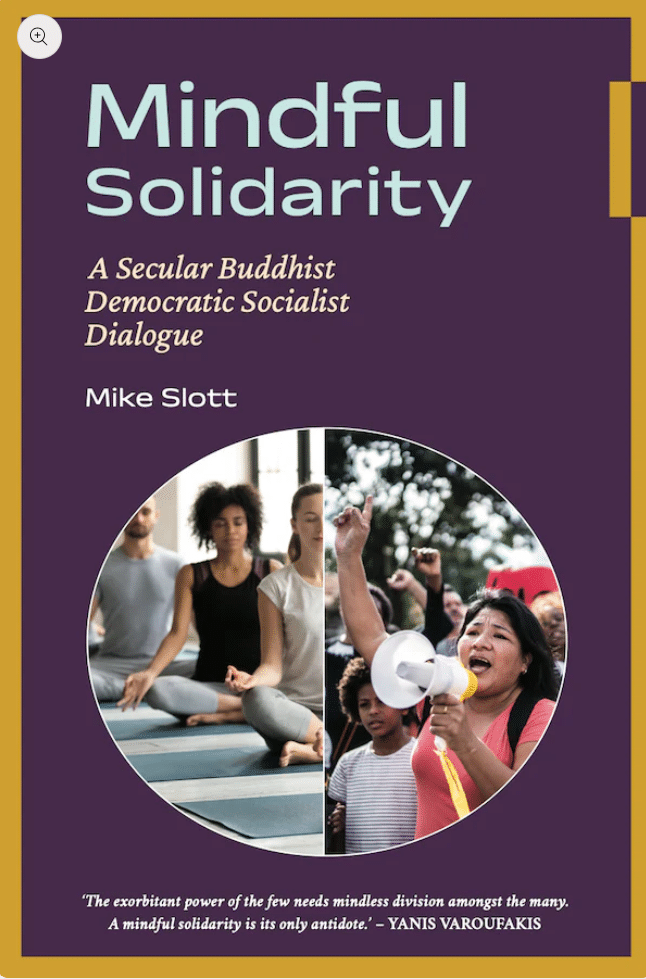
Mike Slott’s book “Mindful Solidarity” (currently only available in English) offers a thoughtful and well-founded analysis of how Buddhist insights and practice can enrich progressive political movements, while arguing that Buddhism itself can be rethought through a radical social perspective. As someone who worked for decades as a trade union activist and organizer and later discovered Buddhist meditation and philosophy, Slott brings a unique perspective to the ongoing discussions about the relationship between Buddhism and social change.
Key Arguments
The book’s central argument is the necessary integration of Buddhist teachings with radical political perspectives. This integration connects the Buddhist view on reducing suffering with the political understanding of how social structures prevent people from living a fulfilling life.
While Buddhism offers profound insights into how our tendency towards greed, hatred, and delusion causes suffering, it lacks an adequate understanding of how exploitative and oppressive social systems are a relatively independent source of suffering. At the same time, left-wing political movements would benefit from the Buddhist emphasis on mindfulness, compassion, and the recognition of human vulnerability and interconnectedness.
Analytical Approach
Slott develops this argument through a careful analysis of key Buddhist concepts and practices. He values Buddhist meditation while criticizing how it has often been reduced to an individualistic pursuit detached from ethics and social engagement. His discussion of non-self (anatta) shows how this crucial Buddhist teaching has been interpreted as an ontological truth claim rather than a pragmatic strategy for reducing suffering.
The examination of the Bodhisattva ideal reveals both its strengths and weaknesses. While Slott acknowledges the inspiring power of this ideal, he criticizes its tendency towards an exaggerated model of spiritual development.
Theoretical Framework
One of the book’s strengths is how it brings multiple perspectives into dialogue – not only Buddhism and Marxism, but also Aristotelian virtue ethics, feminist theory, and Martha Nussbaum’s capabilities approach.
Slott thereby develops a comprehensive understanding of human flourishing. He considers two levels: on the one hand, the fundamental capabilities that all people share, and on the other hand, the societal conditions necessary to develop these capabilities. This connection between individual and societal perspectives bridges personal development and social change.
Writing Style
The writing style is clear and accessible, while addressing complex philosophical and political topics. Slott regularly acknowledges the provisional nature of his arguments and remains open to other perspectives. This intellectual humility embodies the non-dogmatic approach he advocates for both Buddhist practitioners and political activists.
Important Contributions to Discussion
The book makes several valuable contributions to current discussions about Buddhism and social change. Firstly, it offers a well-founded argument for why Buddhism can be rethought through a radical social perspective that goes beyond general calls for more social engagement from Buddhists.
Secondly, the book outlines practical ways in which Buddhist ideas can enrich political activism. The focus is particularly on how groups of activists can collaborate more effectively and constructively.
Thirdly, it develops a secular Buddhist perspective that retains the pragmatic and ethical core of Buddhism while letting go of metaphysical truth claims.
Possible Criticisms
Some readers may wonder if Slott goes too far in revising traditional Buddhist teachings. His rejection of Nirvana as a transcendent goal and his emphasis on flourishing in this life mark a significant departure from how most traditional Buddhists understand it. However, Slott provides compelling arguments that his secular, radically engaged approach better addresses contemporary needs to tackle both individual and social suffering.
Limitations
The book could have benefited from more concrete examples of how Buddhist practices and values can be integrated into progressive political organizations. While Slott offers some suggestions for improving meetings and fostering better organizational cultures, more practical examples would help readers visualize his approach in practice.
Key Insights
One of the book’s most important insights is that both individual and social transformation are essential and mutually reinforcing. As Slott argues: “Creating a flourishing life requires us to cultivate inner conditions for true happiness while transforming external conditions so that they reinforce the inner ones and create the material, cultural, and political foundations for a dignified, meaningful, and happy life.”
Vision and Framework
The emphasis on human flourishing as a goal, instead of individual enlightenment or social revolution alone, offers a compelling vision for integrating spiritual and political practice. Slott carefully explains what he means by human flourishing, connecting ideas from various philosophical traditions with practical everyday experiences. This provides clear guidance for practitioners who wish to implement his approach.
New Ideas in the Book
“Mindful Solidarity” connects areas that have mostly been considered separately until now. The book links secular Buddhism with political theory, ethical questions, and practical organizational knowledge. This results in a new approach that is both theoretically sound and practical. This approach shows ways in which personal development and social change can be shaped together.
Target Audience
The book will be valuable for several target audiences: Buddhist practitioners interested in social issues, political activists seeking more sustainable and helpful approaches to organization, and anyone interested in the connection between individual and social change. While some sections deal with demanding philosophical analysis, the book remains understandable for general readers.
Conclusion
In a time when many are looking for ways to skillfully respond to complex social and ecological crises, “Mindful Solidarity” offers valuable guidance for integrating inner and outer change.
The book’s vision of a secular, radically engaged Buddhism provides resources for developing both personal and collective capacities necessary for a more just and flourishing world.
The book’s vision is a practice of Buddhism that is both secular and politically engaged. This approach offers practical tools for two levels: for personal development and for collective, societal action for change.
Both are necessary to create a world that is more just and in which all people can lead a flourishing life.
Interview with Mike Slott on his book “Mindful Solidarity”